
Behind the Image
MOON DROPS
Inspiration
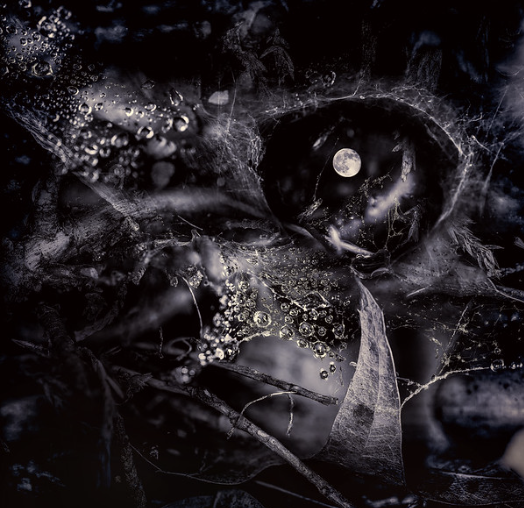
The photographs that comprise Moon Drops were captured under—and inspired by—a full moon. I was drawn to the light dancing off the ground vegetation along a retaining wall near my house in Cambridge, Massachusetts. The foliage was still laden with drops of water from a gentle rain shower earlier that day. Perfect storm, as it were: a magical scene with all the props for an intriguing composite image.
Moon Drops was juried into and featured in “Very Superstitious,” an exhibit sponsored by the Arlington Center for the Arts and has been displayed in group shows sponsored by Array Contemporary and The Cambridge Art Association. It has also been on loan to several Boston- and Cambridge-based businesses.
Moon Drops exemplifies my goals as a visual artist: to provide viewers with portals for exploring the mundane world about them in novel ways, and to navigate alternative realms that lie at the intersection of the predictable and unpredictable—and the what is and what if.
Technical/Technique
Moon Drops is a dye sublimation print on aluminum. The print is made by applying a heat press to a sheet of transfer paper on which the image has been printed (in reverse) with special solidified inks. Once heated, these solidified inks vaporize into a gas and infuse the pores of the metal (hence the term “sublimation,” which refers to a solid transforming to a gas without an intermediate liquid state). The pores instantly seal, so the ink and the image (no longer reversed) become part of the substrate. Hence the durability, and the unique look and feel.
Compositionally, Moon Drops consists of nine images that have been blended into a cohesive scene. All of the images, with the exception of the moon, consist of “focus stacks.” Focus stacking entails taking a series of photos of the same subject with a tripod-based camera. Each photo has a slightly different focal point. A special mount on the tripod, called a “focus rail,” allows for moving the camera closer or farther away from the subject in very small precise increments. A lens equipped with focus stacking capabilities can change the focus internally, obviating the need for a focus rail. However the stack is obtained, specialized software is used to blend the individual images, so the final single image reveals far greater depth of field than a single photo could.
Focus stacking is primarily used in macro and close-up photography. All told, about 200 images went into the making of Moon Drops. If you look at the paths of drops, you’ll notice they are in proper focus, thanks to the focus stacking technique.
As a final touch, a light blue-purple gradient was applied to augment the sense of enchantment and wonder.
Gear
Moon image: Nikon D500 + AF-S NIKKOR 70-200mm f/4G/ Macro photography: Nikon D850 + AF-S VR Micro-Nikkor 105mm f/2.8G. Focusing stacking software: HeliconFocus